HW4
per http://informationcomputingandthefuture.blogspot.com/p/hw-4.html
1) Recall the topic that you did a Delphi analysis on and/or a topic that you wrote about in other HWs. Think about finalizing this as a term project topic, or decide on another topic. Now you have a topic (you can change it later if you decide to).
- write up project issue ~250 words
I am most interested to know the history and issues around GPT3, so I propose an overview essay discussing the history of natural language processing models, recent and current advancements in the technology, popular reporting topics, the energy impacts of running the models, ethical considerations for use of the models, foreseeable future trends and impacts of this technology on our lives. This is a broad scope; I'd start with a discussion and timeline of key AI and computing architecture advances and that made GPT3 possible including neural nets with back propagation, advances in NLP algorithms in particular, and data-centers on demand and data architectures where a server is just a component of a scalable solution; describe and critique the process that OpenAI went through to create their models, and their motivation; discuss the role of curation of training data; summarize reporting from those who have tested the product and the issue of radicalization and why it has not been released for broader public use; consider how it might be further improved or made more human-like and if that is even desirable; discuss differences in the current state of the art and human cognition + the origins of free will (per Chomsky) and if that can ever be simulated. Also I read recently that Microsoft had signed an exclusive contract for its use; dig into that.
- "What would be a good thing to do next on this project?"
I've been collecting links in the popular literate and making notes; re-read hw2/hw3 notes and revisit these links, and form an outline of what the essay will look like. Visit UALR library site for any overview papers that already exist on this topic.
2) Look into the intrade.com mess.
What happened?
- CFTC and Irish authorities investigated unregulated securities; site closed.
What is the current status?
- While Intrade is gone, betting markets exist worldwide such as betfair/flutter entertainment
- Death of Intrade (reason.com): "Records show that ancient Egyptian gambling fanatics frequently wound up working in stone quarries"
- Further research topics: what is "consistent with the public interest as defined by the Commodity Exchange Act"? Virtual offers in the SPP market? How about this week's gas contracts and the fact that availability was limited while demand was not; are markets even in the public interest in this case? My current thinking is no; if you have no choice but to sell or to buy, you shouldn't be participating in a market. Markets only work with low barriers to entry and exit.
Then - *after* you've done that! - check this link and assess the likelihood that the hypothesis of the article is true or false.
- Likely. Risky bucket-list item for someone in deep financial and legal crisis and unexplained health troubles? Oh yeah, that's a suicide with plausible deniability. I'll withhold judgement but share that suicide never stops the pain; it multiplies it and spreads it around.
3) Would your Delphi method question (or any other foresight question you would like to ask) work as a prediction contract?
- My question was: “When (if ever) will over half of U.S. restaurant diners choose to pay with bitcoin vs. USD?”; not without modification. Not binary yes/no question that can be answered on a specific date.
4) Write up a prediction market contract based on your Delphi method question. It should look something like the sample contract discussed in class and linked from the syllabus entry for this week.
- My question was: “When (if ever) will over half of U.S. restaurant diners choose to pay with bitcoin vs. USD?”.
- This needs to be measurable in a binary way, on a certain date.
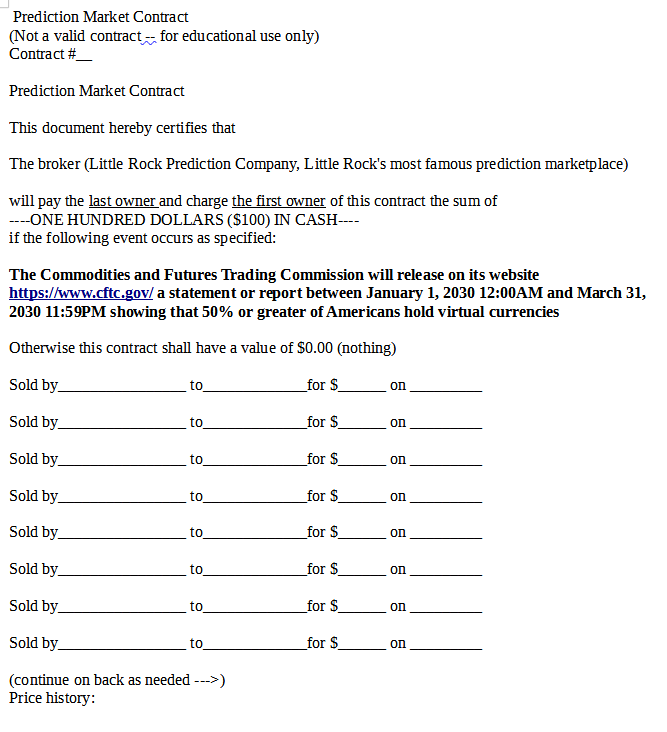
- I looked for reporting from the IRS and CFTC on virtual currencies and found none; if one existed a contract could say "A CFTC report released between January 1, 2030 12:00AM and March 31, 2030 11:59PM will show that 50% or greater of Americans hold virtual currencies", since it will have a yes/no value on a certain date.
I'm not impressed with the text handling capabilities of Wordpress so here's an image:
5) Consider the video "Really Achieving Your Childhood Dreams." It is about the future... your future. We saw it in class, but it is also available on youtube if you want a refresher (or were absent), at http://www.youtube.com/watch?v=ji5_MqicxSo.
a) What were at least three ways he suggested to help achieve your childhood dreams? Do you agree with them? Why or why not?
- Bring something to the table; you'll be more welcomed
- I agree with this; recently I saw an opinion that was basically: don't follow your dreams but instead be very good at something and you will have more opportunities open up. I find this a practical path for most people.
- The brick walls are there to stop the people who don’t want it badly enough. They’re there to stop the other people.
- Disagree. It's a sure sign of privilege to be able to bulldoze through the brick walls; glad that worked for ya.
- "Find the best in everybody. People will show you their good side. No one is all evil. Everybody has a good side, just keep waiting, it will come out."
- Disagree: as a society we have rejected this, otherwise "life in prison" wouldn't be in our vocabulary.
- I listen sometimes to a clique of old men on the ham radio being objectively terrible to those not in their group. I don't know if waiting them out will ever have any benefit.
- However I think *some* people do come around; I've certainly experienced this. But Everybody? Doubtful.
b) "It has been said that seeking happiness as a direct goal is a good way not to be happy, because happiness is not achievable as a direct goal, but rather occurs as a side effect of helping, or contributing to, or being important to, others. Discuss this important issue."
My discussion starts by analysis of a single person, my father Gene, who was unusually happy; perhaps the happiest person I've ever met. Gene was happy with a simple railroad factory-style job, a modest home, his wife & family, church friends and his faith in Christianity. I only knew him later in his life and missed out on his early failures. He had type-1 diabetes from an early age and managed to live 92 years, work the railroads, marry and raise a family, retire, volunteer his time at churches, hospitals and the AARP, take care of his wife in her declining years and still manage to be an inspiration to most of the people he met. I think he did seek happiness as a direct goal in ways; his philosophy was simple: each day, when we wake, we have a choice to be happy or to complain. Gene chose not to complain, often to a fault. Even clearly failing in health he would tell doctors "if I felt any better they'd either make it illegal or tax it". Indirectly towards his own happiness he chose to help others, and importantly, told me that one of the nicest things you can do for someone is to allow them to help you. This was his recognition of the indirect seeking of happiness by other people that we have the ability to see to fruition by accepting their help.
Another point I'd like to make about happiness: From my own perspective, poverty is by far the hugest contributor to misery; it is a recognized contributor to poor health and life outcomes. I had the good fortune to work the summer of 1990 in a menial labor position where my coworkers were economically trapped in the job to the point that they willingly endured the abusive policies and outbursts of the company's owners. When paychecks were late due to company cash-flow issues, none of my coworkers were told the reason but were afraid that asking might further jeopardize their pay. The job was physically taxing and low wage; I would be surprised if any of the long timer employees had the resources and stamina to attend classes at night to better their chances in business. As a short-time student employee, my escape was a Federal student loan and classes resuming in the fall. I formed an opinion from my experience: If you are economically trapped, you can't possibly follow your dreams. Following dreams and passions means that risks must be taken but people who have more month than paycheck and people depending on them often can't take any risks; the paycheck is too important.
People can find happiness through success. A key for success is to be good enough at something (that other people will pay for, like shining shoes, making explosives, being a judge, etc) that you can store enough reserves to accept the risk of trying something that might be better. And then take the risk. And then be lucky, and not have addictions or structural discrimination to hold you back. Can you imagine Randy Pausch with a youtube habit, or glued to a smartphone? How about in a world where racism limited his earliest advances? Would he have been as happy?
There is a negative correlation with excess wealth and happiness; lottery winners are often miserable from managing their winnings and instant fame. I bought a ticket for a multi-million lottery once and was a basket case worrying about what I would have to do if I won. From my situation of relative comfort after a career in technology, more wealth would probably make my life more complicated and subjectively worse, but that is obviously not true for the majority of people who continue to buy tickets.
I once attended a work retreat that studied the question "what do you want". Common answers were "more money", or "to retire". Clearly, work alone is not making most of us happy, and many of us don't get to live to retirement age or live for long afterward, so finding happiness in what we do on a daily basis is critical to maximizing the area under our personal happiness curve.
Personally: I am happy when I am perceived by myself and others to be useful, to produce more than I consume, to have value to others, to be wise enough to advise, to be good to myself and to bring out good in others. How can anyone be happy only taking, only consuming, when nobody will miss them when they are gone? Even at 92, Gene managed this: he was productive; he shared his smile and directly positive outlook with everyone he met.
6) Read 20 pages in the book you have obtained. Explain what you agree with, disagree with, learned from it, and how your views agree with or disagree with the reviewers of the book you are reading.
Book: Predictions, pages 12-32, essays about French Anderson and Noam Chomsky, two rather controversial voices from the end of the 20th century.
Anderson carried out the first gene therapy on human patients in the late 1980s and was a leader in development of Recombinant DNA therapy (which I believe is being used today in Covid-19 vaccines). The debate at the time was around the use of gene therapy being a slippery slope towards trait selection in human offspring similar to the 1998 Hollywood movie Gattacca, called "germ-line gene transfer". He believes that this is inevitable, as no parent would willingly pass on a lethal gene to the their children if there is a safe and effective way of eliminating those genes. While he cautions that the only way to stop germ-line gene transfer is to develop an informed society which prevents the misuse of technology before it is too late, he also writes this gem: "The people of the future will care as little about our opinion as we care about long-forgotten mandates from our nineteenth-century predecessors". His prediction, which would make a pretty good prediction market contract, is that "by the year 2030, gene-based therapy will have revolutionized the practice of medicine" and further "I define gene-based therapy as any therapy based on replacing or modifying the functions of genes in the body". I learned all of this, agree with much of it, and disagree that an informed society will be able to prevent the misuse of technology. (EDIT: oh my; he spent much of the interceding time in prison)
Chomsky's short biography notes how prolific he was with this writing and efficient he was with his time. His mode of survival was to constantly be writing or thinking about future lectures, attending to letters and emails, interview requests and even departmental administration. The biography details his work in linguistics, and his early opposition to the Vietnam war. Something that stood out to me as particularly relevant today is his statement that "propaganda... is to democracy what violence is to totalitarianism" and his attacks on neoliberalism by which democratic principles are exploited in order to subordinate people to the profit needs of a handful of private interests -- something I witnessed the aftermath of first-hand during the protests in Santiago Chile during a work-related visit in October 2019 when the local electricity company building was burned. Neil Smith, author of Why Chomsky is Important, attributes his fanaticism to the desire "to be seen to have done something decent with his life" which relates nicely to the previous task in this HW. His prediction is that if humans don't kill ourselves, generations to come will continue to have fascinating inquiries to pursue. He discusses questions of language origination, will and choice, and notes that conclusions will come "as no great surprise for those who take for granted that humans are part of the organic world". Agree: his views on propaganda and neoliberalism, near as I can tell, having witnessed the social divide in Chile that has apparently grown since the fall of the military dictatorship of Pinochet. Disagree: nothing yet; clearly his writing at the time was influenced by the cold war and the threat of nuclear annihilation that has occupied a less prominent role in the public discourse of the 21st century so far.
My views on the book relative to reviewers: This book is dense; it crams a wide variety of thought into just a few pages, and repeats this formula 30 times. It is a difficult read because of this, but as some reviewers noted, the book format lends itself well to episodic reading.