HW 5
per http://informationcomputingandthefuture.blogspot.com/p/hw5.html
A1) Report on two prediction markets other than intrade.com.
In places with developed electricity markets, there is usually a way to buy or sell future energy a fixed time in advance, such as the day before the day the electricity is to be instantaneously produced and delivered. The vast majority of energy is contracted to be generated or consumed in forward markets before the time of production, so predictions of demand along with generation forecast information for variable generators such as wind, solar an run-of-the-river hydroelectric dams are important. In some cases the question would work well for an Intrade style prediction market: "I predict that electricity this hour tomorrow will be less expensive than the forward market price today" would be a good test for offering a generation contract in the day-ahead market with the hopes of buying the energy back cheaper on the day of production. Buyers of electricity, such as your municipal electric company, often bid their predicted demand into the forward markets to minimize the risk of exposure to volatile prices in the real-time markets. Generating companies are often bound by rules that require that they offer generation contracts in the forward markets at competitive terms, since manipulating the market by not offering would be trivially easy for the larger providers. I can't possibly do justice to the notion in a few sentences but I frequently refer to Power System Economics / Designing Markets for Electricity by Steven Soft (2002), who says "Trading for the power delivered in any particular minute begins years in advance and continues until real time, the actual time at which the power flows out of a generator and into a load." The market maker, which in central Arkansas is the Midcontinent Independent System Operator, benefits from having the information that an efficient day-ahead market can provide. It takes from hours to days to start large power plants, and the day-ahead market outcomes indicate a need for commitment of power plants and the procurement of fuel for the next day. Thus, the MISO is happy to pay the costs associated with developing and hosting the market, and theoretically gets more efficient scheduling of power plants in return.
I know much less about my next topic, event ticket scalping, or "ticket secondary market liquidity engineering" perhaps. Tickets can be though of as a futures contract for a seat at an event at a certain time. Scalpers may buy contracts based on their estimation that demand for an event, such as a popular concert or sports game, might exceed supply and the face value of a ticket may go up. Alternatively they may predict that the face value of the contract is simply too low and enough people will pay more for them in the future for the scalper to make a profit. Also, if an individual holds a ticket, and predicts that he or she can't use the seat at the contracted time, she may choose to sell the contract on a secondary market at less than face value to avoid the total loss of value of the contract after the event. Certainly ticket scalping is a controversial topic with conflicting interest of event performers, event hosts, and event consumers. As long as these interests aren't aligned and absent rules that make ticket contracts worthless to anyone but the original purchaser or otherwise restrict trade in the contracts, markets will develop based on predictions of future value differences.
A2) Critique the prediction market idea. Why might their predictions be wrong?
Over time, enough data can be gathered to make correct predictions the majority of the time for many markets, but all prediction markets suffer from the obvious fact that we can't perfectly predict the future. Last week's weather was the most disruptive for energy markets in decades. Likewise, a ticket scalper who correctly predicts that demand for an outdoor event would outstrip supply might not predict a cold rain on the day of the event and be left holding many worthless contracts. While the fact that we disagree about the future gives rise to these markets in the first place, participating in a prediction market carries some risk no matter how good the predictions are, and the magnitude of the risk is unknown until it is realized.
To the point of efficient, liquid prediction markets as a whole being wrong - there is some amount of risk that is unknown to all market participants; the market outcomes can't possibly reflect this risk. Current events can also sway the opinions and moods of the majority of market participants in an instant, causing market outcomes to change dramatically in a short time.
BTW I am not an economist; I'm too unsure of believing things like the efficient market hypothesis because sometimes it is glaringly obvious that the majority of us are being fooled. But I'm not a successful markets naysayer either. I just try to understand the best I can.
A3) Pausch claims, "... when you do the right thing, good stuff has a way of happening." ... Discuss your opinions on this important issue.
If I have an opinion it is based on how societies develop and are reflected in our biology through what might be called a bridge between societal macro-evolution and our own micro-evolution. Here goes: (1) We have evolved over time to form social constructs that contribute to the survival of our species such as contributing to the common good or helping the underprivileged. Similarly our societies have developed constructs to deal with harmful behavior such as shunning or entanglement in the justice system. (2) Contributing in a positive way to these social constructs may be an innate individual drive that has been shaped by micro-evolution, and our individual recognition of the contributions by other members of our society may be beneficial to society as a whole in a macro-evolutionary sense. (3) In general, "lead[ing] your life the right way" is a way in which we not only become productive for ourselves but are able to share and multiply our productivity through others to the betterment of society. Pausch claims this was his motivation to become a professor, and a society benefits and is simply more likely to survive difficult times when its members act collectively as well as individually. The reward "will happen automatically" on average because it is baked in to who we are at this moment in the evolution of our species and society. What benefits society is rewarded by society and what detracts is punished, generally. (4) There are always exceptions. Good people get cancer; terrible people exploit the commons or commit atrocities for their own reward. Societies that figure out how to deal with these issues will have a leg up on societies that don't. Currently the notion of the collective good in our own society seems to me to be diminishing in value; in my opinion this isn't a good sign for our long-term vitality.
Note: I know little of evolution, sociology, psychology, and religion; you asked for opinions and mine are as worthless as the next person's. But it seems to me that most long-surviving religions have a strong social betterment component that improves public health or is otherwise a net benefit to the resilience of a society, and on an individual level, what goes around comes around so to speak. Karma is real, but only because we collectively accomplish it.
A4)Write up 200 words on how your project topic will affect your personal future.
I think with the advent of an AI that can write perfect, convincing prose, that I personally and all of us collectively will be forced to examine the role of trust in public discourse. Already it is impossible to trust that a photograph represents a real snapshot in time, and very soon, convincing videos complete with perfect audio will be faked in such a way that we can't tell if they represent reality. But up until this point I have trusted in the written word - that if thoughts were coherently explained with reasonable assumptions and logical conclusions, that a human had to be behind the keyboard. Even if that human doesn't have by best interests at heart (and they often don't), or even my country's interests, up until now I could trust that the writer had Humanity's best interests at heart. Consider the fantasy mechanized-biology race "the Borg" from the Star Trek series; would you evaluate a written piece differently if you knew it had been written by the Borg?
Less fantastically, I noticed that the advertisements I see on Twitter are being influenced by all my search terms. I saved this one; it is advertising me the service of essentially unlimited AI-generated permutations of ad copy for market response testing for online advertising, to determine which ones an audience responds best to:
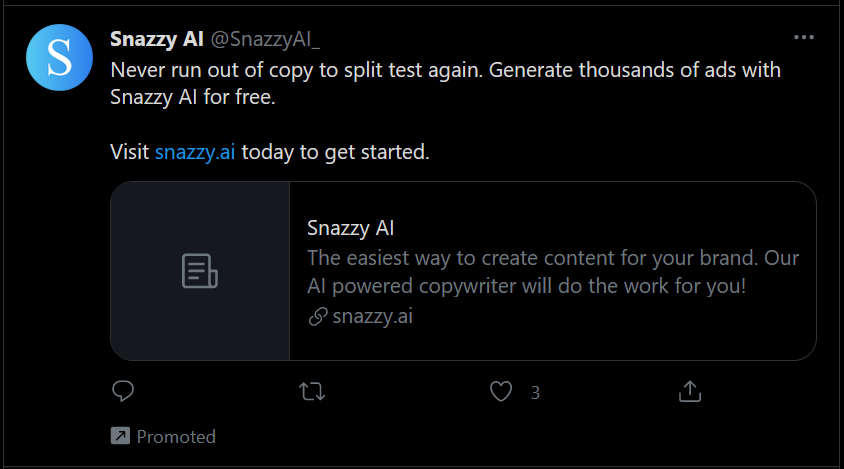
Reflecting a little, I can see this is already happening, and that I have been the recipient of very persuasive click-bait recently that I've found myself clicking on. Who is dumb enough to click on click-bait ads? Me, apparently, if they are well crafted enough. And if you as a marketer can try essentially unlimited variations and measure the best, you have a very powerful tool. While internet advertising campaigns are relatively benign, with ad copy (or propaganda) that is being crafted with the skill of the best orators in recorded history but not with the most noble of intent, our critical thinking skills will be put to the test more often than any other period throughout human history.
a5)Identify 8-10 sources of information about your project topic (web pages are fine). Provide the URLs and give 2-3 sentences describing each one.
- OpenAI paper that describes there approach of Generative Pre-Training to boost model performance. This is fundamentally what OpenAI is doing; I recall reading in another source that they are now "throwing CPU at the problem" with bigger models.
- What is pytourch and how to use it: https://towardsdatascience.com/what-is-pytorch-a84e4559f0e3. I really just want to spend some time understanding everything that is said on this page, but the key is that matrix multiplication and other operations needed in deep learning is 15x faster on GPUs than CPUs.
- NLP AI google ethics flap: https://www.reddit.com/r/OutOfTheLoop/comments/lo470c/whats_going_on_with_googles_ethical_ai_team/: “It's more about the environmental impact of training large models.” “that models these large are making no attempt at curating the data, and as such are taking in as much internet text as possible and training on it without the ability to consider subtext, context, or nuance.”
- Gpt3 examples at help scout: https://www.helpscout.com/blog/ai-in-customer-support/ show that the model lacks specifics on real-word problems.
- Pop sci on how neural nets may help us to understand how brains learn: https://www.quantamagazine.org/artificial-neural-nets-finally-yield-clues-to-how-brains-learn-20210218/
- Interesting tweet about “prompt engineering” and GPT3 https://twitter.com/mark_riedl/status/1363883539004030987; I didn't know prompt engineering was a thing, but I can relate to the term "model whisperer".
- Talk To Transformer demo; I've tested a number of short writing prompts and have found the results fascinating. This is the previous version of the model GPT2; I haven't found a GPT3 demo yet.
- GPT2 comparison of large and small language models when given the task of generating fake news. https://towardsdatascience.com/creating-fake-news-with-openais-language-models-368e01a698a3
- GPT and iGPT discussion of biases in unsupervised training.
- Image GPT This is GPT2 with small images; I spend a stupid amount of time looking at the "completions" part of the page. It is clear to me that the model is able to vary output with each run and come up with stylistically relevant and sometimes creative completions. I'm reminded of Garry Kasparov saying that Deep Blue's chess game was too human-like to be from a machine.
- A Reddit thread with insightful criticism of what OpenAI is doing, and another thread discussing scale and cost of igpt
- https://transformer.huggingface.co/: I'll just quote, emphasis mine: "The almighty king of text generation, GPT-2 comes in four available sizes, only three of which have been publicly made available. Feared for its fake news generation capabilities, it currently stands as the most syntactically coherent model. A direct successor to the original GPT, it reinforces the already established pre-training/fine-tuning killer duo." It allows text auto-completion of short sentence fragments; presumably one call to the model to determine what comes next.
- Talk to Transformer - an incredible demo of GPT2 (I think) completing a thought in the same style as the prompt. I've been amazed at the writing but I don't detect any introspection so far.
Building Your Personal Future
A6) ("Do"). Based on your work on this topic, identify something that will progress you toward your vision, such as a strategic action that helps address a strategic issue, such as a core strategic issue that is a prerequisite to others. (On your blog, simply note if you succeeded on this question, but don't put the answer there.)
Success.
A7) ("Monitor"). Consider the results of the "Do" step you just completed. How well did it work, or is it working now? If well, then you are on track. If instead any problems of any kind arose, see 3. (On your blog, note if it worked or not, but don't put what it was.)
The action is scheduled.
A8) ("Accountability"). Consider the results of the "Monitor" step you just completed. If it worked, reward yourself! If things did not go as well as hoped for, analyze why and what you could do to circumvent them. Take notes on this for future reference. (On your blog, note the result of this question in general terms, but don't put any details.)
I will know more next Thursday, March 4.
A9) Grad students only. Read 20 pages in the book you have obtained. Explain what you agree with, disagree with, learned from it, and how your views agree with or disagree with the reviewers of the book.
Book: Predictions, pages 34-54 essays about and predictions by Arthur C. Clarke and Paul Davies. The Clarke biography mentions that he is the father of communication satellites, predicting geostationary orbit communication satellites in 1945. Clarke is modest about his prediction, stating "If I hadn't written that paper in '45, ten people would have done it in the next year, you see" and "I may have accelerated the conquest of space by 15 minutes or so." When this biography was written, Clarke wanted to settle the cold fusion debate - at the time, claims of cold fusion were made that never panned out - that he believed could be as revolutionary as the discovery of fire. His enthusiasm has been met with criticism from others in the scientific community but is quoted in his book of essays as saying "it has been more interesting to see where (and why) I went wrong, than where I happened to be right." He comments on the Internet "It could very well mean the end of the nation state, and the development of... tribes, who only owe minimal allegiance to their country of birth. ... Everyone will have an enormously wide but shallow background of experience that overlaps only a few percent." Clarke ends with his predictions: Life will be found on Europa before 2050, AI will reach human levels after 2020 (!) leaving the planet with two intelligent species and one evolving far more rapidly than biology would permit, and by 2057 humans will have permanently colonized space. By the end of the century a "space drive" that interacts with the structure of space-time will be developed and the first explorers (he doesn't state biological or AI) will set off to nearby star systems.
Agree: analysis of where I've been wrong is more fruitful than recounting where I've been right, and AIs may be reaching human levels about now. Disagree: Humans will find a reason to permanently colonize space.
Paul Davies has always been interested in the big questions: the beginning of life, the nature of time, the mind of God, the origin of free will, and generally anything that was hidden. He has studied quantum phenomena and cosmology, and became a leading thinker in field of quantum gravity. He has also written about human consciousness and perception. He believes that the universe is rational and "there is some sort of deep meaning to physical existence" which puts him at odds with many others in the scientific community. His thinking about the origin of life is that it is the result of information being organized in some way and perhaps began spontaneously in many places throughout the universe. While admitting to some criticism that his books had been unashamedly popular and written for a general reader, he had come to the conclusion that the more the public knew about science, the more government funding was likely to be available for research. His predictions for this century include the solution to at least one of the great origin mysteries; i.e. the origin of the universe, or of life, or of human consciousness. He predicts that the ability to create designer life in the laboratory may be realized before mid-century. He clearly wishes to find independently-arising life on Mars due to the philosophical implications that follow. He asks if a man-made machine could experience qualia like the sound of a bell or the color red and tell us about them.
Agree: that the universe is remarkably stable and seems better designed than just random variables for c and other forces that happen to be just right. I don't pretend to know why this is. Disagree: that life will be found to have arisen spontaneously throughout the universe; it seems quite the freak accident to me, but I know nothing.
Interesting: I asked GPT2 about the color red at the inferkit demo. What is in bold was my prompt, and what follows in italics is the continuation of the thought: The color red is perceived by all but a slim minority of humans as a vivid hue associated with warmth, anger, and even good luck in some cultures. How is the notion of the color red, or the qualia of the color red, represented in the brain? How is that blue feeling when you see the blue sky really a different neural pathway, and how might it be explained? It might be that the color blue that some have assumed represents our subjective experience of the color red is actually not the feeling blue but another one called thalamic color, which refers to the color of specific cells in the brain. These cells, found in the brain, send information to the thalamus, where it is interpreted by the brain as a color, resulting in the "blue
Eh, that wasn't very good. Maybe if I knew one of those "prompt engineers" from the tweet in my links section above I could learn about how to get more out of this thing.
fin