HW2
per http://informationcomputingandthefuture.blogspot.com/p/hw2.html
A1: Long ago it stuck in my head that an easy way to calculate the total amount for annual percentage increase of a number by a percent is to multiply the number by (1 + percent) raised to the power of the number of years of interest. This gives the same answer as calculating the percent compounded per year and adding it up a row at a time, but is much easier. So to find the doubling time of any non-zero number c at 6% growth annually, just find x where 2c = c*1.06x, or more simply, when 1.06x = 2. Plugging in values for x in a binary-search manner, the value of x=11.896 yields close to 2.0. Double checking with the spreadsheet rows method, after 12 years of 6% growth the final value will be 2.012 times the original value. 1.0612 is also 2.012, so this method holds.
Not being able to solve 1.06x = 2 for x directly bugged me so I looked it up. https://tutorial.math.lamar.edu/classes/alg/solveexpeqns.aspx tells me to use a logarithm to solve for x when x is the exponent: 1.06x = 2 can be written as x ln 1.06 = ln 2, or x = ln 2 / ln 1.06, or x = 11.8956610459. I love having the sum of world knowledge at my fingertips, but will it last?
A2: I have considered many topics for a term project, but the one that interests me the most right now is "what is GPT3 and how can I use it", or more generically, "tracking the progression of human-like interactive automated language models and making some estimates of the future". OMG people have made chatbots with it. From what I understand of it so far, it is a natural language processing AI trained on an enormous amount of text data from the Internet with the ability to output natural sounding language and even computer code with what seem on first glance like original insights. My thought is that some research on what it is and how it came to be, what is the scale of the product and how much energy does it consume at that scale, what is the likelihood that me as a UALR grad student can get some time on this model, how insightful and original are the results, and can I get GPT3 to write my final paper for me (note: this is likely one of the few contexts in which this behavior would not be considered cheating - let me know if you disagree). If I'm successful at that, my final presentation could actually be the research and methods of setting the GPT3 API up, the generated text (assuming GPT3 is self-aware enough to write about itself), and a critique of the insights in the generated text, some comparison with earlier language model outputs and a prediction for when we can call IA something like "creative", "insightful" or "spiritual". Stretch goal: see if I can get it to describe how to design an artificial intelligence model better than itself.
Edit: that may be a bit ambitious. That's really ambitious, and apparently API access is hard to come by. Reviewing the project requirement again, I'll target a 3000 word paper (not AI assisted). How about: Research OpenAI and GPT3; get a sense of the scale of what they are doing and how it could profoundly impact out lives in the future, and present a 20 minute slide-deck summary of what I found. Send me an email if that's too boring or it will be covered in a class this term already.
The bucket of potential ideas is large; if any of these sound better or if I determine early on that I CANNOT use GPT3 for a project, here is a list of things I've jotted down as topics and notes that could be turned into a project:
- The deindexing of data: why can I not find anti-theft system codes for a 2000 Ford F150 anywhere authoritative on the Internet? Will the open internet be more closed in the future due to market forces?
- Trust & data. Publishing - print media - role going forward? How can we trust the Internet? Information dilution, climate data and the psychology of denialism: how to prove the data is what it is, given funding bias or other incentives. “People have always been dumb. History has only recorded the smart. That’s not the case anymore” -- what will this mean for the future? How can there be a future data authority when even the fact checkers are perceived as biased, and when misinformation masquerades as fact? Is the desire for misinformation the re-emergence of myth?
- Ham radio HF communications as a solution to the dangers of corporate concentration of critical communications
- Fat tails and downside risk in future scenarios, or how to dig oil again after a technical disruption when all the easy oil is gone? Potential for the loss of technology from concentration in the hands of the few due to market forces, or how would you make a transistor or tube from scratch today?
- Multiple antagonistic neural nets modeled after the human brain: when do we declare it having achieved consciousness?
- Market harmonics: predicting the future using hidden frequencies with FFT (i've been noodling on this for a while but don't know how practical it really is)
- Extrapolate the rate of CO2 increase; predict when we will all lose rational thought due to CO2 poisoning (see this chart for scarily exponential looking data, and this paper for a synopsis of the effects of CO2 at levels that will be reached by the end of the century at this rate)
- Is the enterprise database dying? Is the future of structured data a database that can be spun up from flat files, used and tossed like paper plates?
P.S. do any of these sound like a Masters thesis or project? Particularly the perception of information as trustworthy by holders of disparate modern mythological beliefs?
A3.A: My question was: "When (if ever) will over half of U.S. restaurant diners choose to pay with bitcoin vs. USD?"
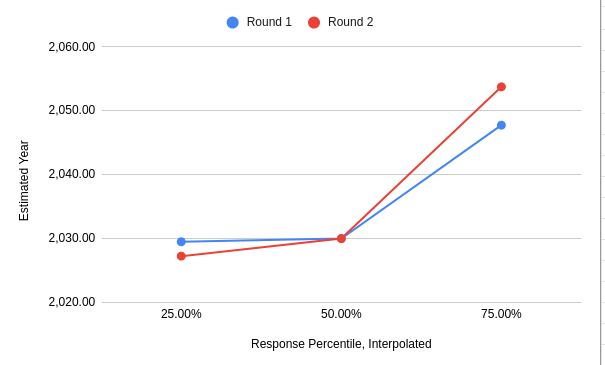
Round one estimates data were 2025, 2028, 2030, 2030, 2035, 2037, 2080. The middle 50% of values median is 2030 and the interpolated middle 50% range is [2029.5,2047.75].
After round one, participant discussion centered on topics of convenience of paying, fiat monetary stability, United States influence and the value of the dollar, and the independence of cryptocurrency.
Round two estimates data were 2025, 2025, 2028, 2030, 2035, 2045, 2080. The middle 50% of values median is still 2030 and the interpolated middle 50% range is [2027.25, 2053.75], possibly indicating that the group as a whole became less certain after the discussion.
A3.B Like all college kids these days, I found some material on YouTube. It is difficult to quote and tedious to sit through information that can be skipped in a written format, but it is also difficult to find something useful to do while on the treadmill, so I killed two birds with one stone with this excellent 50-minute video lecture by Jeffrey Franc entitled "Delphi Tenique - The do nots and why nots" referencing the book "The Delphi Technique in Nursing and Health Research" by Keeney et. al, 2011. Below are my notes and comparisons with our class exercise.
Observations from class exercise: First of all, we're clearly not a panel of experts. Also, to do Delphi right according to this fellow it is a slow process; there should be a couple weeks between rounds, with formal questionnaires, anonymous answers, and rounds until consensus is derived. In class, we only performed the quantitative analysis; our answerable question really should have been based on the results of open-ended questions in round 1, so what we did was modified Delphi. Also the process should iterate until consensus is reached instead of being capped at two rounds. 8 to 12 experts are recommended. At 7 in class, we were pretty close to the optimal number. The experts should have knowledge about the issue under question (this typically takes hours of the expert's time). Confidentiality of the answers should be assured; we certainly didn't do that in class.
This is interesting; the definition of consensus must be decided before the data is obtained, otherwise the data may taint the definition and therefore throw the study into doubt. While our metrics were predetermined by the professor, this point could have been emphasized. I'd like to hear more about the improper application of statistical methods.
One thing we did in class that this fellow didn't, is panel discussion and sharing of individual rationale for our answers. Also, our panel selection for our questions are a better approximation of a random sample than 12 of our friends that are more expert on a particular question. However, since experts aren't truly random in any Delphi study, we should avoid using confidence intervals or p-values that need a random sample to be valid. I think we did OK here; we just reported the data in the middle 50%.
A3.C Shortcomings of the class exercise (compared to a full Delphi study):
- Expert panel was not selected from subject matter experts
- Round 1 to determine the questions was not panel based
- The selected questions may not have met the criteria for a Delphi study
- Anonymity of respondents was not assured, and therefore strong personalities can influence the outcome
- The final rounds were stopped before consensus was reached
Any of these could be fixed at the expense of time and possibly money to pay for experts, but then it wouldn't be a class exercise.
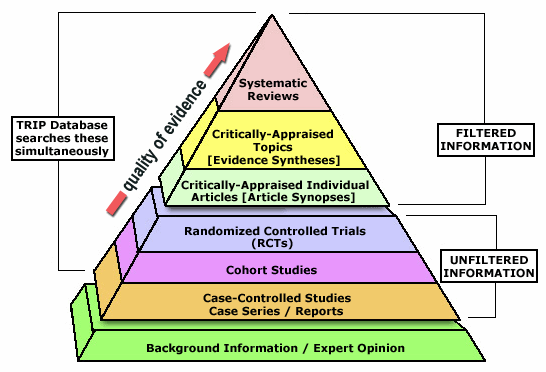
Saving this here because I just want to make a note of it. Delphi Problems: Cannot produce right or wrong answers. Consensus doesn't mean we have a correct answer. Interval validity is largely unknown. Delphi is a tool of last resort; we should be aiming higher on the evidence pyramid if possible. On the strength of evidence scale used in Evidence Based Medicine, what we did would rank below the bottom rung of "expert opinion" since our panel was not comprised of experts.
A4: I ordered 4 books because I am terrible at decisions. Technically I am in compliance with the HW because I did order "a book about the future"... and 3 more with it. I'll winnow it down to one based on reviews:
- Title: RELIGION & SCIENTIFIC FUTURE Author: Gilkey, Langdon
- Hardcover, 208 pages
- Published June 1st 1970 (this date is special to me for some reason)
- Tracking #: 9241990246915900452090 USPS
- Status:
at USPS in LR as of Friday afternoon, expected Monday 20:00DELIVERED
- Goodreads: https://www.goodreads.com/book/show/3613582-religion-and-the-scientific-future 4.75/5, 4 ratings, no reviews on goodreads
- Google search reviews
- https://digitalcommons.andrews.edu/cgi/viewcontent.cgi?article=1262&context=auss
- https://www.amazon.com/RELIGION-SCIENTIFIC-FUTURE-Langdon-Gilkey/dp/0865540306
- Reviews: Seems like a study of knowledge vs. wisdom, the assertion that it is a false belief that knowledge leads to virtue, the social purpose of myth and where that might be going, "The irony of the situation of modern man is that he cannot master the use to which his technological knowledge will be put." (Edward W. H. Vic) It appears to have been an attempt to inject theology into the heart of the secularization of the late 1960s. This may hold some insights into our current reality of "alternate facts" being introduced in the place of science since the late 2010s. I think this could be a good contribution to a project or thesis on the acceptance of information in a society that clearly has a hunger for misinformation and possibly modern myth, but may not be the book for this course.
- Title: Future Shock Author: Alvin Toffler
- 430 pages, Published 1971
- Tracking #: 9241990246918811341194 USPS
- Status: expected delivery by Monday 21:00
- Goodreads: https://www.goodreads.com/book/show/466537.Future_Shock, 3.8/5 rating, 4,315 ratings · 312 reviews
- So many reviews. Good ratings. I think I'll pass since so many people have already done it; it doesn't seem to need what little attention I can muster.
- Title: Megatrends: Ten New Directions Transforming Our Lives Author: Naisbitt, John
- First published in 1982. 290 pages
- Tracking #: 9241990233785007041475 USPS
Status: expected Wednesday by 21:00DELIVERED- Goodreads: https://www.goodreads.com/book/show/40758.Megatrends, 3.67/5 rating, 465 ratings · 26 reviews
- Reviews: Many positive reviews, some negative based on the missed predictions, but I don't see that as a negative. Concept of "high tech / high touch. It means that you need to serve people using technology by making them feel human, not part of the machine" (Jason Waldron, 2009). A two star review says "If nothing else, these books serve some purpose, if nothing else they get us to think about where we are going as a society" (Steve Walker, 2014). "Not as good as Future Shock" (Scott, 2014) - hah! "According to the author, we live in a 'time of parenthesis,' a change from an old order to a new one: industrial to information, industrial to high tech, national to world, short to long-term, centralized to decentralized, institutional to self-help, representative to participatory, hierarchy to network, North to South, etc. " (Volkert, 2013) The trend of the reviews is that this book is part of a fad on futurism from before the Internet bubble that made some accurate calls and missed the mark in some areas, so far. The commentary on society as a whole appears worth studying, but perhaps other authors do it better.
- Title: Predictions: Thirty Great Minds on the Future (Popular Science)
- 328 pages, hardcover, published 2000
- Status:
Shipped, ABE shows no tracking # yetDELIVERED - Goodreads: https://www.goodreads.com/book/show/2831822-predictions, 3.26/5, 42 ratings, 3 reviews
- Reviews: "The intensity and the breadth of thought depicted is extremely stimulating" (Marjory Munson, 2013). "Each author gets 3-7 pages of background (why their opinion matters), followed by a 2-3 page 'prediction' for the 21st century." (Blayne, 2010). "Published in 1999, Predictions consists of short essays by 30 intellectuals looking forward to the 21st century ... The format is perfect for browsing one author at a time." (Catwalker, 2020). So basically it is a collection of 30 author profiles and essays, mostly by non-futurists, with strong opinions on the state of society in 1999 and a prediction for the future. Consensus of reviews is that the breadth of authors included is a strong point, and the main value of the book this broad introduction and the ability to find other works by authors that make a statement that resonates with the reader. A potential weakness could be that these people aren't futurists or presumably skilled at making predictions, but that also gives me the opportunity to see if their thinking displays known tools or formalities taught in this course.
First choice: Predictions. I can get through the whole thing in the weeks left in this course mostly 2 authors at a time, with a couple of 3 author sprints. If it ever gets here, this sounds like the the most appropriate book for this course in that each week I could read a different couple of essays and provide my own input, and by the end have an introduction to the futuristic thinking of 30 noted minds from around the end of the 20th century. Wow!
Second choice: Megatrends. The hit-and-miss nature of the predictions will be interesting to study, plus the commentary on the social situation that many reviewers say hit the mark.
The other two will go on the bookshelf for reference material. Future Shock appears to be widely regarded as excellent but I have only limited time and attention on this blue ball. Religion and Scientific Future has value in that it was written after a period of heightened religious activity in this country and during the beginnings of the computer age, and appears to offer insight into the human desire for myth that continues to shape society today; this could be valuable if my studies go in the direction of social acceptance of information as truth.